


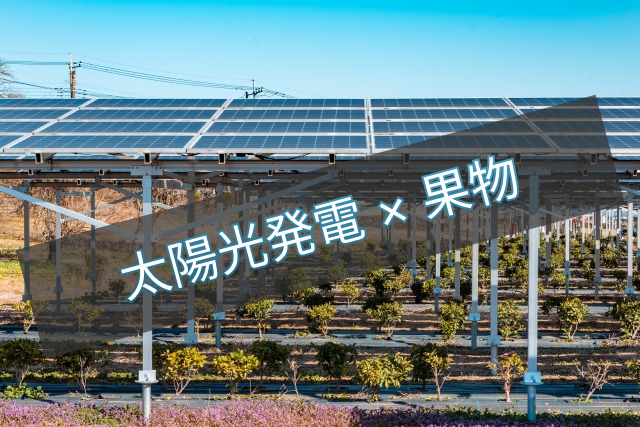

What scene comes to mind when you hear the words ‘growing fruit’? Nobu?

Like that


Right. So did I. But there are more and more farms that combine a ‘solar power system’ and a ‘farm’ like this.

I see~. But it’s going to be shady, and why do you need to set it up in the first place?

Good question. I’m going to show you why ‘solar power✕ fruit growing’ is getting a lot of attention.
Awesome!
As you may know.
You have probably seen photovoltaic panels on the roofs of houses, shops and mountainsides.
If you have never seen it, you need to do the exercise. Let’s go to town lol.


Now, here is the main question.
Why are solar power and orchards a good match?
The keyword is
First of all, solar panels are big, aren’t they?
They are not the size of the palm of your hand. They are bigger than a person.
(The panels are roughly 1m✕1.6m. Even if we were taller in height, we are narrower in width. (If we were sumo wrestlers, it might be wider.)

But Japan is small.
And there are many mountains.

Ratio of forests to land area in Japan.
Land area of Japan: approx. 37.8 million
hectares, of which forests account for approx. 70% (25 million hectares),
The remaining approx. 30% is agricultural land, residential land, etc.
As this image shows, if the forests were removed from Japan, only 12.8 million hectares would remain. However, we don’t know how much is left, so we converted it to the number of solar panels.
(1ha=10,000㎡、10,000/1.6=6,250 Panels、6,250*1.28 milion =80 billon )
What? You can put so many solar panels! But I’m only talking about “if every possible place in Japan were covered with solar panels”.
It’s a weird world just to imagine it.
Roads, rice paddies, fields, and everything else but the mountains would be covered with solar panels. It’s a world that makes no sense.
So in reality, you can’t put that many. At best, they are on buildings or on the ground.
Back to the topic at hand, land in Japan is limited. And the land on which solar panels can be placed is also limited.
Hence,
From this perspective, put yourself in the shoes of a trader who wants to sell solar panels.

I’d love to sell panels, but there are already so many on houses and shops… Yes! If it’s on farmland, the area is big enough, so if we can install it on top of the farmland, out of the way of the crops, then the farmers will be our customers! That would open up a lot of sales channels!
It will give a glimpse into the ulterior motives of the supplier.
The wider the customer base that can be sold to, the more profitable it is for the solar contractor and the more profitable it is for the solar contractor.
Also, farmers’ deposits can be passed on to consumption, which increases consumption in Japan.
So,
Market expansion: by extending their products into the agricultural sector, photovoltaic operators can open up new markets and revenue streams.
Scalability: photovoltaic operators can expand their operations to meet the needs of larger agricultural operations, resulting in more stable revenues.
Now let us turn to the farmer’s point of view.

If I have solar panels, the crops will be shaded, so there’s less evaporation of water, and I’ll be able to prevent sunburn. If there’s less defects, then the yield will increase.
Another big advantage is that the electricity generated by the solar panels can be used on the spot.
In the countryside, there’s not enough electricity, so it costs a lot of money just to pull the electricity… Solar panels are a good idea.
If you cut out the best parts, it would look something like this.
It would be easier to combine solar panels with an automatic irrigation system.
Let’s now consider the disadvantages from each standpoint.

Compared to ordinary houses and shops, connecting to the existing electricity grid is more difficult due to the complex procedures and costs involved. In addition, as photovoltaic panels are affected by weather conditions, it is likely to generate comments such as “I can’t use the electricity when I want to!” ‘. In addition, as photovoltaic panels require regular maintenance, the overall cost of the system, including running costs, may increase.

The cost of installing photovoltaic panels can be high, making it a significant investment, especially for small-scale farmers with limited resources. Also, solar panels are subject to weather conditions, so there is a possibility that ‘electricity may not be available when you want it!’ ‘. There is also the possibility that crops will be in the shadow of the solar panels, which can cause problems with growth, or that the solar panels will be in the way, reducing the amount of land available for growing the most important crops.
In any case, there is no doubt that solar power is a clean, renewable energy source and a sustainable and environmentally friendly agricultural option.
Please be aware of the good and bad sides and understand each of them, but only at your own risk.
Solar panels and fruit farms, there may still be challenges, but if they work, they could be a lifesaver for farmers. Also, in the countryside, if you work until nighttime, it’s pitch-dark around here, so it would be good to consider storage batteries.
It’s true. So many people and factors are involved in the production of fruit, not just the farmers. When we eat fruit, we should be grateful to the farmers and the people involved!

You’re getting cocky all of a sudden.
Example of a farming-based solar power system.
Seibu Agri, an agricultural business in the Seibu Group, is growing blueberries and grapes in Tokorozawa City, Saitama Prefecture, in a ‘solar sharing’ scheme that combines farming and solar power generation in one location, allowing cultivation even in the shade.
Source (Japanese):https://www.sankei.com/article/20210714-NSFD5NFJSROOPOOUVRSKXJBBUI/
Fruit tree solar sharing is increasing in Yamanashi Prefecture, where fruit tree cultivation is flourishing: a farmer who started solar sharing in 2014 said: ‘The clusters of the Cheyenne Muscat are blue, so too much sunlight is not good for them. Rather, it is better to place them in the shade. Solar sharing is a good match, and this year we harvested 1,500 bunches on 1,190 square metres”. He says.
Source (Japanese):https://solar-sharing.farm/report/coverage/1029/
Author:Yamaguri
Reference(Japanese)
Ministry of Agriculture, Forestry and Fisheries, on farm-based photovoltaic power generation.
