


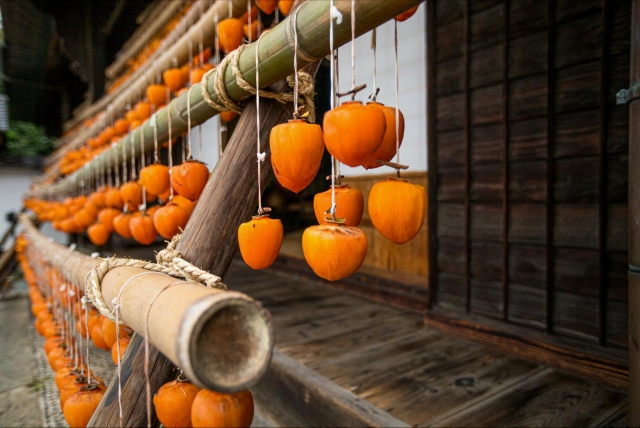
What are Dried Persimmons?
Dried persimmons are dried fruit made from persimmon and are produced in Asian countries such as Japan, Taiwan, and Vietnam. Japanese immigrants introduced the method of making dried persimmons to California, USA. When astringent persimmons, which are not edible as they are, are dried, the astringent component tannin is removed, increasing the sweetness. This sweetness is 1.5 times that of sugar! The surface of the dried persimmon is covered with white powder crystallized from sugar, and in the past, this powder was collected in Japan and used as a substitute for sugar.
History of Dried Persimmons in Japan
The first mention of dried persimmons in Japan appears in the Heian period legal code “Engishiki” as a ceremonial candy. The oldest sweet persimmon discovered in Japan dates back to the Kamakura period and originated from wild trees in the Aso district of Kawasaki City, Kanagawa Prefecture. Interestingly, the history of dried persimmons is profound. During the Warring States period, dried persimmons from the Mino region were presented by Oda Nobunaga to the Portuguese missionary Frois. Additionally, the “Dojo Beehouse Persimmon” from Gifu Prefecture won a silver award at the 1900 Paris World Exposition and a gold award at the 1904 St. Louis World Exposition.

Let’s Make Dried Persimmons!
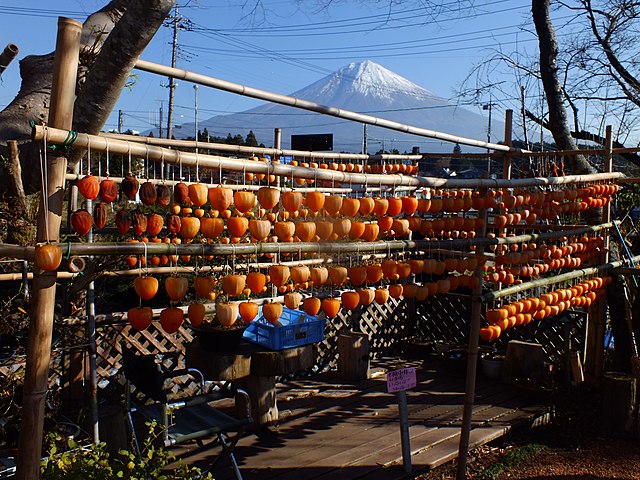
https://commons.wikimedia.org/w/index.php?curid=89004302による
You can make dried persimmons at home, whether you live in a detached house or an apartment with a balcony. You will need 30 astringent persimmons with T-shaped branches, 15 pieces of packing string cut to 60cm, a food-safe alcohol disinfectant spray, and disposable rubber gloves.
1.
Peel the persimmons, leaving the stem intact. Tie two persimmons together at both ends of the string.
2.
Boil the persimmons in boiling water for about 5 seconds for disinfection. Wipe them with kitchen paper and hang them on a drying rack, ensuring they don’t touch each other. If you’re concerned, you can secure them with clothespins. Make sure to dry them in a well-ventilated area and protect them from rain.
3.
After about a week, when the skin becomes hard, gently massage the persimmons while wearing disposable gloves. After another week, massage them thoroughly to the center. Be gentle during this process to avoid mashing them. They are ready when they have a vertically elongated shape, a deep orange color, and wrinkles, approximately one month after starting the process.
*If you’re worried about mold or flies, disinfect with a commercial alcohol spray.
*Dried persimmons paired with cream cheese go well with sake or white wine!
<Reference Link (in Japanese) – August 30, 2023>
Wikipedia 干し柿
https://ja.wikipedia.org/wiki/干し柿
丸果石川中央青果 果実の知識 干し柿
http://www.maruka-ishikawa.co.jp/fruits/items002/hoshikaki.htm#:~:text=日本の歴史に初めて,を探ったのでしょう%E3%80%82
川崎市麻生区」禅寺丸柿について
https://www.city.kawasaki.jp/asao/page/0000057747.html
JA東京中央会 禅寺丸柿(ぜんじまるがき)
https://www.tokyo-ja.or.jp/farm/edo/54.php#:~:text=禅寺丸柿は,あるとされています%E3%80%82
干し柿の作り方 つるし柿・カビ対策・保存方法
https://marron-dietrecipe.com/desert/desert_tsurushigaki.html