Ladies and gentlemen, have you ever heard of Tamarillo? The other day, while browsing the internet, I discovered this plant while looking for something new to add to the empty space in my garden. The criteria was that it needed to be a fruit-bearing tree that could overwinter outdoors in the region where I live. After it arrived, I realized that despite it being advertised as frost-resistant to -3℃, internet sources indicate that frost causes the above-ground parts to wither. Apparently, to bear fruit, the tree needs to reach a certain size. If it withers in winter, will I ever be able to harvest fruit from it? I’m watching how it goes, albeit with a sense of potential failure.
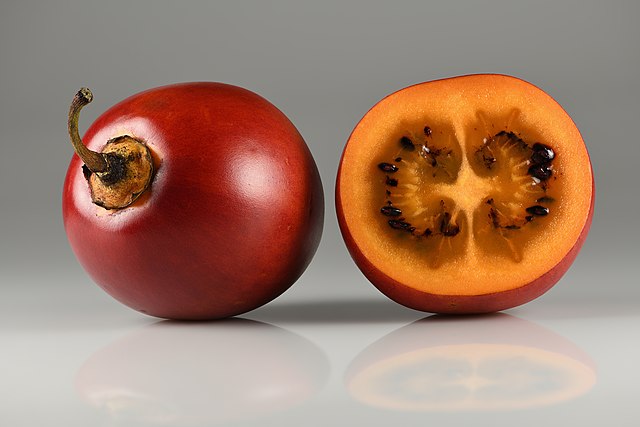
Tamarillo (Solanum betaceum), also known as tree tomato, is a fruit that does indeed resemble a tomato – just slightly.
Tamarillo is a shrub of the nightshade family, originally found in the Andes region of Ecuador, Colombia, Peru, Chile, Argentina, and Bolivia. However, it has now spread worldwide and is cultivated in subtropical regions globally. The name Tamarillo varies by region and it was generally referred to as “tree tomato” before 1967. Subsequently, the New Zealand Tree Tomato Promotion Council renamed it “Tamarillo” to distinguish it from garden tomatoes and emphasize its exotic nature. Notably, New Zealand is one of the primary producers of Tamarillo.
Tamarillo trees grow quickly, reaching heights up to about 5 meters. They hit peak production in their fourth year and have a lifespan of 5 to 12 years. Their leaves are large, simple, evergreen, and emit a strong scent. However, describing them as having a strong smell doesn’t quite do justice. After sniffing the leaf of my Tamarillo, the aroma is… well, let’s just say it’s not a pleasant one. It smells like urine! While Tamarillo is not a common sight, if you ever come across one, give it a sniff. But be warned, don’t sniff too much as it may affect your appetite!
Tamarillo flowers are pinkish-white, and they bloom in clusters of 10 to 50 small flowers. Each cluster produces 1 to 6 fruits. While the plant is self-pollinating, the flowers have a strong scent that attracts insects, facilitating cross-pollination with other trees, which may improve the quality of the fruits. The fruits are egg-shaped, about 4-10 cm long. The color of the fruit depends on the cultivar, with red Tamarillo being the most common. The inside of the ripe fruit resembles a tomato, and its taste is said to be a mix of tomato, mango, and passion fruit. To really know what it tastes like, you’ll have to grow and taste it for yourself.
Tamarillo is a very low-calorie fruit and is rich in dietary fiber, minerals, antioxidants, vitamins, and other plant-based nutrients beneficial to health.
In New Zealand, where Tamarillo is native, the fruit is harvested between May and October. When choosing a Tamarillo, pick one that is well-grown, brightly colored, uniform, and ripe enough to eat. Varieties of Tamarillo include colors like orange, golden yellow, deep red, and maroon. Avoid small, shriveled fruits, as well as those with damage or bruises. At home, ripe fruits can be stored for 5-7 days, or up to 10 days in the refrigerator.
As for cooking, there are various ways to utilize its unique flavor (though I can’t verify this as I’ve not harvested any). You can eat it raw, but since the skin is
bitter, it’s typically removed before eating. Aside from eating it as is, it can be sliced and used as a topping for fruit salads, cakes, ice creams, and sandwiches, or made into jams. Regardless of how you choose to use it, Tamarillo seems to offer many exciting culinary possibilities.
In conclusion, while cultivating Tamarillo might present a few challenges, particularly with its frost-sensitivity, it certainly is a unique plant to explore. Its strong aromatic leaves, colorful flowers, and egg-shaped fruits make it an interesting addition to any garden. More importantly, whether you’re tasting it fresh or incorporating it into your cooking, Tamarillo’s distinct flavor and rich nutritional profile make it worth a try. If you happen to come across this ‘tree tomato’ in your local nursery or garden, don’t forget to give it a sniff – just remember not to sniff too much!