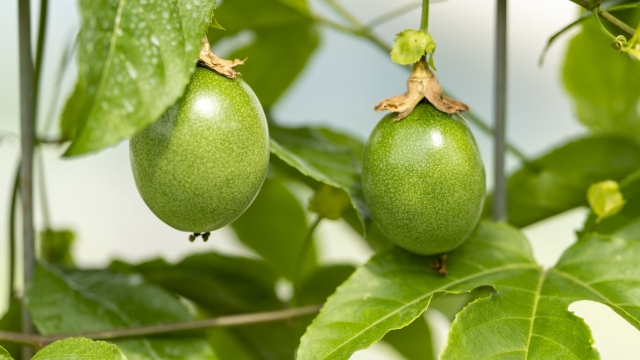
Hello everyone! It’s me, Kobay, pretending to be “Zundamon”! Today, I’m going to talk about passion fruit!
Passion fruit is a climbing plant classified under the Passifloraceae family. It is believed to have originated in South America. The name “passion fruit” was given by Spanish missionaries who visited South America in the 16th century. They interpreted the shape of the fruit’s flower as a symbol of Christ’s Passion. Specifically, parts of the flower were seen as symbols of Christ’s cross and the crown of thorns. This beautiful flower and fruit captivated many explorers and botanists, leading to its introduction in Europe and Asia. Since then, it has been cultivated in various regions and is now a beloved fruit worldwide.
In Australia, passion fruit juice is very popular. This juice is made by squeezing the pulp of ripe passion fruit and adding water and sugar. It’s known for its refreshing tartness and is a favorite drink during the summer.
Major producers and uses:
Major producers of passion fruit include Brazil, India, and Vietnam. In these countries, various cultivation and harvesting methods have been researched to produce high-quality passion fruit.
Cultivation in Japan:
In Japan, passion fruit is mainly cultivated in warm regions like Okinawa, Kagoshima, and Miyazaki. It’s also produced on islands like Hachijojima and Amami Oshima. The peak season in the market is from summer to autumn. Recently, specific passion fruit brands have emerged in Japan, with certain regions and farmers developing unique varieties and cultivation methods.
Taste characteristics:
Passion fruit has a unique flavor with a balanced mix of sourness and sweetness. Nutritionally, it’s rich in vitamin C, iron, and dietary fiber. Compared to apples, passion fruit has a higher vitamin C content and a distinct flavor.
Winter pot planting tips:
By spring, when temperatures consistently stay above 15°C, potted passion fruit plants can be moved outside. The pot size should be chosen according to the plant’s growth. A mix of well-draining akadama soil and leaf mold is recommended.
Plants similar to passion fruit:
The Passiflora, like passion fruit, belongs to the Passifloraceae family. In Japan, it has been used as a traditional medicine for a long time. It has a long cultivation history in Japan and can be found in many regions.
Delicious ways to enjoy passion fruit:
Beyond desserts, passion fruit is increasingly used in salads, drinks, and sauces. Especially when used as a sauce for fish dishes, its tartness enhances the flavor. For those living in warmer regions (like Kanto and westward), if you spot an unfamiliar melon-like fruit while walking around your neighborhood, it might just be a passion fruit!