



Previous Article Is here
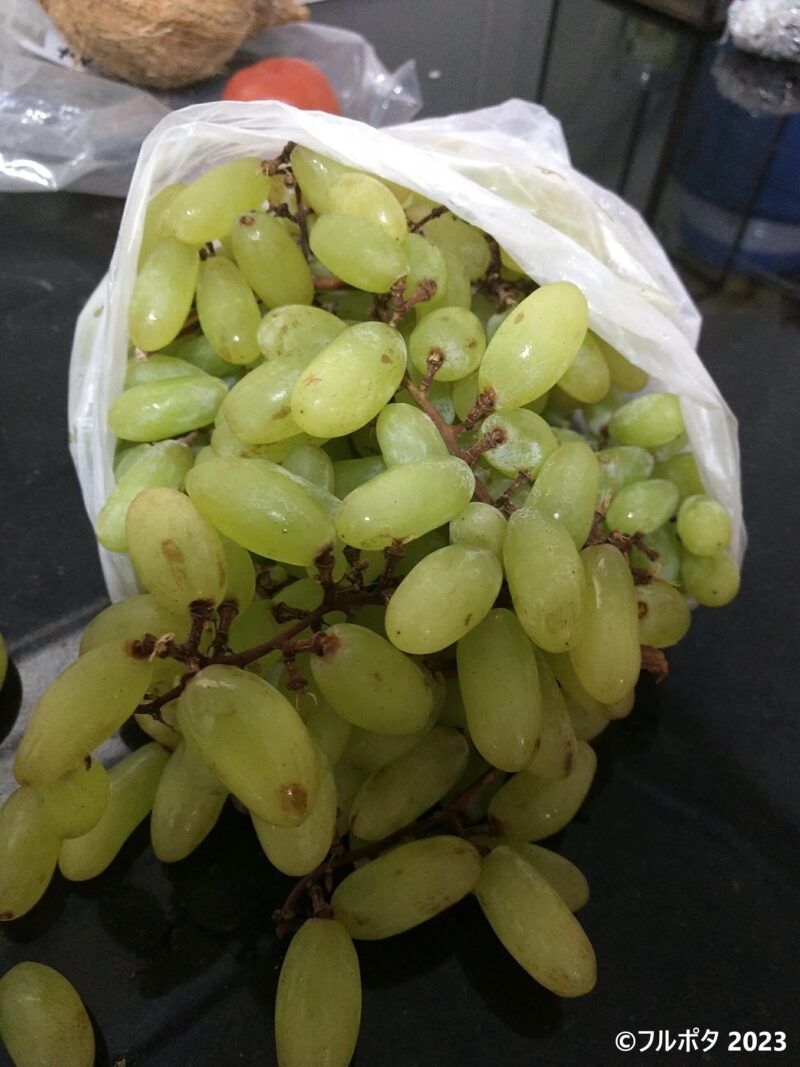
One day, I had to live in India for work and I saw a lot of grapes being sold on the street. In the early 2010s, they were sold for 50 rupees (about 100 yen) per kg. When I tried them… wow, delicious! The flesh was long and light green. The skin was thin and crispy, and the texture was like a wiener. It made a “crunch” sound when I bit into it, and the skin didn’t linger in my mouth. The flesh was crunchy and refreshing sweet, and they were cheap and easy to eat like snacks! This was exactly “the ultimate grape that I imagined”! (The photo is from that time)
After that, we named them “snack grapes” at home and ate them every autumn. And now, years later. I wandered around the supermarket looking for that taste that I had on the street in India, and tried various kinds of grapes, but none of them could beat those snack grapes.
“I miss those snack grapes.”
I could only reminisce about them, but when I wrote this article, I looked at the old photos and thought that it would be nice to at least know the variety (I couldn’t communicate with the Indian guy in language so I didn’t know). And then it hit me. There’s Google image search now!
What Google-sensei taught me was a Wikipedia article (see details at the end), which said that this grape is a variety called “Sultana” and “is thought to have originated from Asian regions of the Ottoman Empire”. It seems to be processed into raisins and other things and is quite famous worldwide.
Raisins seem to be imported and sold here, but I don’t know if fresh ones can be grown or sold in Japan from what I searched online. Too bad. If you ever find these grapes somewhere, please give them a try!
Cited sites: Wikipedia authors, 2022, “Sultana (grape)”, Wikipedia.
(retrieved 12 January 2023)
https://ja.wikipedia.org/w/index.php?title=%E3%82%B5%E3%83%AB%E3%82%BF%E3%83%8A_(%E3%83%96%E3%83%89%E3%82%A6)&oldid=89180924)